May 13, 2011

Blog Pick: Fooducate

After our Food Revolution speaker-and-movie series, we got an influx of emails. We want to eat better food. One way to do that is to begin to better educate ourselves. For that there’s Fooducate, a blog and mobile app (pictured here) that breaks down what makes up the food on grocery store shelves.

The Fooducate blog offers regular updates on topics, like artificial colors, food allergies, and unfamiliar back-panel ingredients. But what’s even cooler is the Fooducate mobile app. For those moments when you’re grocery shopping and you can’t decide if a cereal has too much sugar—or not enough real fruit—pull out your smart phone and use the Fooducate app (available at the App Store) to scan the bar code. Fooducate will pull up a rating of the product as well as a list of product warnings (too much sugar, artificial ingredients, controversial additives). In seconds, you can decide if you’re dropping a product into your grocery cart or putting it back on the shelves.

-Kazia Jankowski


Kazia Jankowski
Associate Culinary Director

April 8, 2011

CSA Season Begins

The Boulder Farmer’s Market kicked off last weekend—and next weekend, most ski mountains shut down for the season. Which means that right now, you’re probably thinking more about skinny carrots than skinny skis. If that’s the case, you’ve got many options to get your hands on the season’s produce.

Of course, there are the farmer’s markets (in Boulder and Denver), but there are also countless CSAs. These Community Supported Agriculture programs allow you to buy a share of a farm and receive regular deliveries, all summer long, of the farm’s best. Early summer, greens will fill your fridge. Mid-summer, expect juicy, red tomatoes. And late summer, watch out for squash and pumpkin.

To kick start the CSA season, Eileen, our in-house CSA devotee, and our Culinary Team share their favorite local programs:

Stone Bridge Farm CSA
Ollin Farms
Oxford Gardens Boulder
Grant Family Farms

Please let us know if you have others.

-Kazia Jankowski


Kazia Jankowski
Associate Culinary Director

March 29, 2011

Eric Skokan - Chef and Owner of The Black Cat


On Tuesday we were fortunate to be joined by Eric Skokan, the chef and owner of The Black Cat farm-to-table restaurant in Boulder. Eric grew up on a farm in Virginia, has been a professional chef for more than 20 years, and just in the last three years started his latest, and most personal venture.

Eric's philosophy is to reduce, reuse and recycle as much as possible. Food scraps go to the chickens and pigs, and because he grows most of what is served at the restaurant, packaging is drastically reduced, as well. For the few items he can't grow himself, Eric tries to source GMO-free, local, and organic products, with his goal for the restaurant being to someday be 100% GMO-free.

Eric grows hundreds of varieties of vegetables, fruits and herbs, as well as several breeds of chickens, turkeys, pigs and sheep. He says that depending on the farm to supply the restaurant has been a wonderful creative challenge, and as such, he has found ingenius ways to use what is in season all year round (even in the winter!) while still keeping the menu fresh and unique.

Check out his seasonal creations at The Black Cat.

Photo courtesy of http://www.jamesbeard.org/

--Christie Wood

Christie Wood
Culinary Assistant

Blake Hurst - The Voice of the Farmer


Last week we hosted our third Food Revolution speaker, Blake Hurst. Blake is a third generation farmer from Missouri. He raises corn, soybeans and bedding plants for commercial sale using conventional methods.

Blake provided a lot of great counterarguments to the other views we've heard so far this month. He believes that GMOs are advancing the possibilities of farming, making crops hardier, increasing yields, decreasing the risks of disease or blight and overall improving the possibilities of various crops, without causing any significant risks to consumers. He also believes that the selective use of chemical herbicides is actually beneficial to the earth, because they allow farmers to use no-till farming methods, where, instead of having to plow weeds under, thereby loosening the soil and allowing more soil erosion, they can instead just spray to control weeds, and prevent as much soil and chemicals from running off into rivers and ultimately oceans. In response to the argument that organic crops have as high yields as conventional crops, Blake explained that in many cases, organic farming requires more crop rotation and field resting in between plantings than does conventional farming, which can sustain the same crop in the same field year after year. Therefore, an organic corn field may produce the same yield in year one, but only be plantable every three years, whereas a conventional corn field produces that same yield every year, so on year-over-year basis, the yield is considerably greater from the convetional farm.

Blake continues to work to make the voice of the farmer heard, and to defend many of the views and practices that have come under fire in recent years. He is the president of the Missouri Farm Bureau Federation and, when he's not busy on his farm, does as many speaking and contributing engagements as he can.

You can read more of Blake's views in his essay, "The Omnivore's Delusion."
Photo courtesy of http://www.mofb.com/

--Christie Wood

Christie Wood
Culinary Assistant

March 23, 2011

Ann Cooper, "The Renegade Lunch Lady"


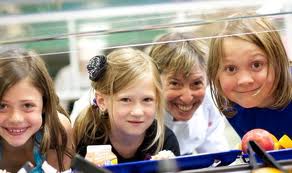
Last week we were fortunate to have Ann Cooper join us as part of our ongoing Food Revolution speaker series. Ann, also known as "The Renegade Lunch Lady," has made it her mission to improve the health of the next generation. She has worked with school districts all over the country to create more nutritious lunches, add salad bars for kids to school cafeterias, educate kids on healthier choices, and even teach them how to cook for themselves.


Ann first gained national recognition for her overhaul of the Berkeley, CA school district's cafeterias, which she did by eliminating processed and packaged foods and replacing them with fresh, local, and when possible, organic options. She has also worked with school districts to help improve the environment for kids eating lunch through such measures as lengthening lunch periods (to allow kids to get through both a hot lunch and salad bar line and still have to eat) and having recess before lunch (so younger kids don't rush through or skip lunch just to get outside to play). Beyond this, Ann has worked alongside some of the biggest names nationally, in both food and politics, to help further her cause and disseminate her message. She is also taking steps to help shape policy and government spending in order to make healthier lunches possible for more school districts.
It is through changes like this that she hopes to put an end to the prediction that for the first time in history, kids born in the year 2000 have a shorter life expectancy than their parents, this due directly to diet-related illness.
Learn more about her efforts on her website: http://www.chefann.com/

Cathryn Olchowy
Culinary Director